AI-Powered RTF File Translator

Translate Rich Text Format documents across 100+ languages

rtf translator online

Translate RTF Documents Without Breaking Compatibility

RTF lasts for decades. Now translation does too.

Rich Text Format (RTF) was designed as a universal document standard that works across Microsoft Word, LibreOffice, Apple Pages, Google Docs, and countless legacy applications. This cross-platform compatibility makes RTF essential for legal archives, government records, and enterprise systems that span multiple software environments. The challenge has always been translating these files without corrupting the embedded formatting codes that define fonts, colors, alignments, and special characters. Standard translation methods strip out RTF control words, leaving broken files that fail to open correctly. The RTF file translator is built specifically to understand RTF syntax, distinguishing between translatable text and structural markup. Every control sequence is preserved while the visible content transforms into the target language. The result is a translated RTF document that opens identically across any platform, maintaining the exact interoperability that made RTF valuable in the first place. Files are processed with enterprise encryption and comply with data protection regulations.
online rtf translator with layout preservation

How it Works

Three simple steps to translate RTF files with perfect format retention

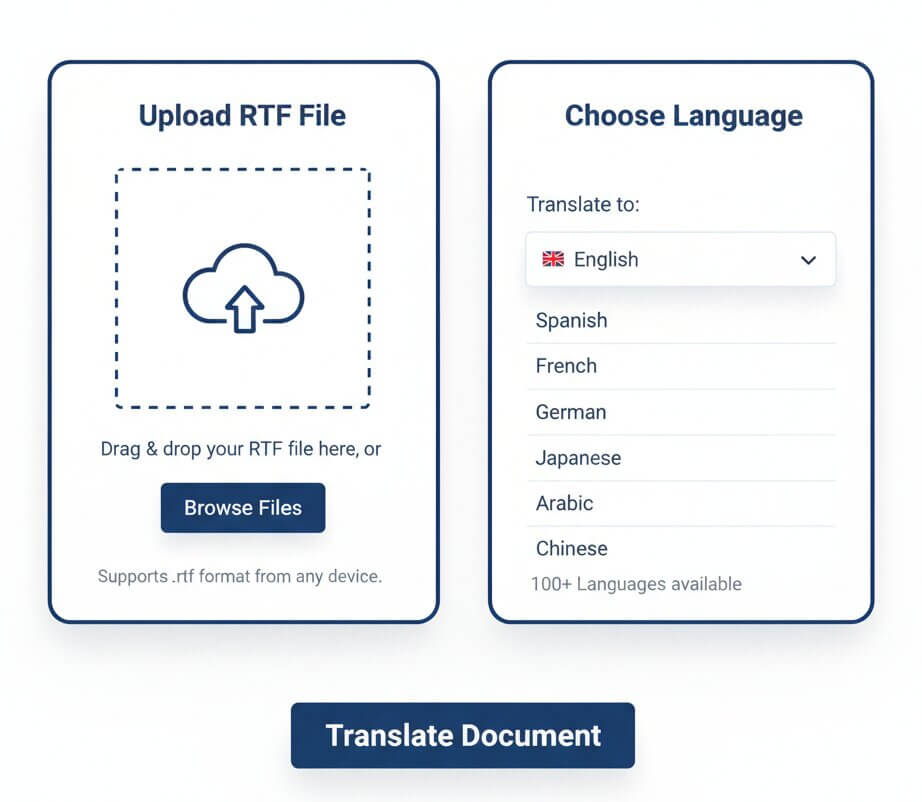
Upload RTF File

Select the rich text format file from any device. The system accepts RTF files created in any word processor, regardless of operating system or software version.

Choose Language

Pick the destination language from 100+ options. Advanced AI processes the text content while isolating and protecting all RTF control codes from modification.

Download Translated RTF

Receive a fully functional rich text format file that opens correctly in every application. Formatting codes remain valid and the document structure stays the same.

Features

Core capabilities of the rich text format translator

rtf translation app

RTF Syntax Preservation

Cross-Platform Compatibility

Universal Software Support

Formatting Code Protection

Legacy System Ready

Multilingual Output

Why translate RTF documents with specialized tools?

translate rtf documents while keeping formatting

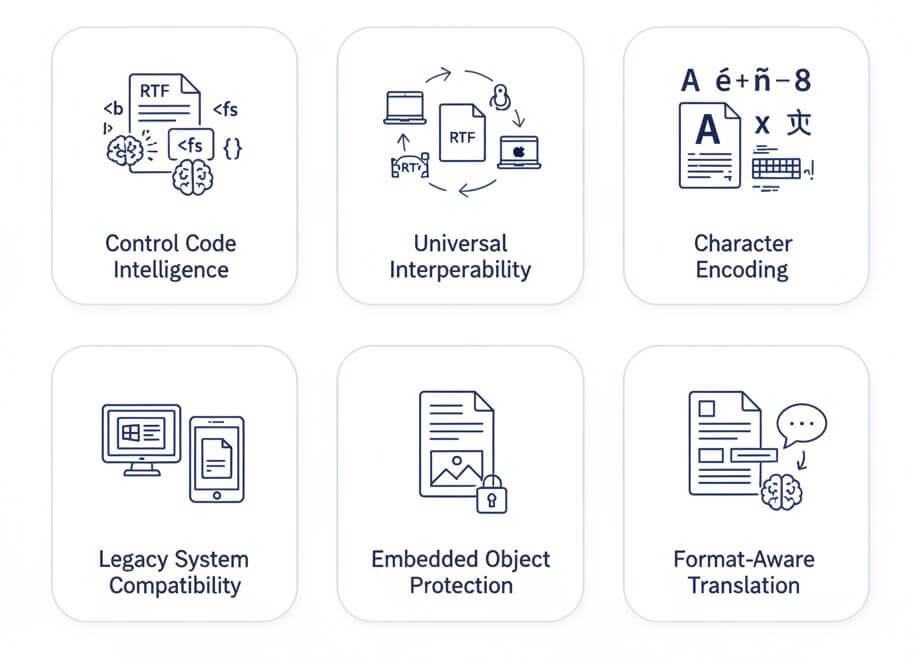
RTF Control Code Intelligence

Rich text format files contain hundreds of control words like \b for bold, \fs24 for font size, and \colortbl for color definitions. Generic translation tools treat these as regular text, corrupting the file structure. The AI translator parses RTF syntax to separate formatting commands from translatable content and every control sequence remains functional after translation.

Universal Interoperability

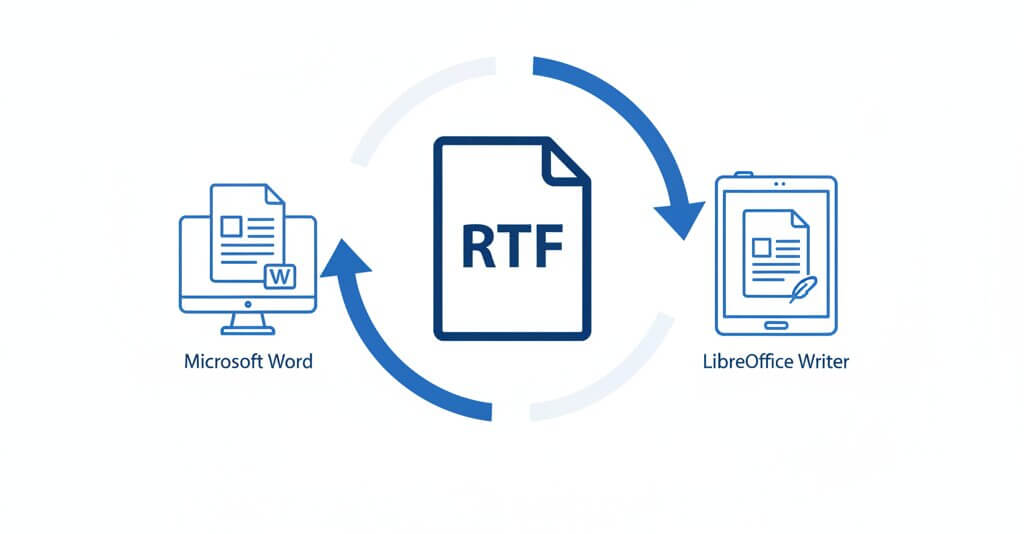
RTF files are valued because a document created in Microsoft Word 2003 can open in LibreOffice on Linux or Pages on macOS decades later. When translating RTF files, maintaining this cross-application compatibility is critical. The translation process preserves the exact RTF specification compliance that allows files to open identically across every word processor and operating system.

Character Encoding Handling

RTF uses escape sequences to represent non-ASCII characters, like \'e9 for é or Unicode markers for complex scripts. Translating into languages with different character sets requires careful encoding management. The rich text format translator correctly generates the appropriate RTF escape codes for every target language, so special characters display correctly in any application.

Legacy System Compatibility

Many government agencies, legal firms, and corporations maintain archives in RTF format because of its longevity and platform independence. These organizations need translated versions that remain compatible with older software systems. The translator generates RTF 1.9-compliant output that works with both modern applications and legacy systems from the 1990s.

Embedded Object Protection

RTF files can contain embedded images, OLE objects, and binary data encoded as hexadecimal strings. Careless translation corrupts these embedded elements, making them unreadable. Our tool identifies and protects all binary sections, embedded graphics, and object references during the translation process so the complete document remains functional.

Format-Aware Translation Quality

Understanding that content is in RTF format allows the AI model to recognize document structure elements like headers, footers, footnotes, and style definitions. This structural awareness improves translation accuracy because the model understands the role each text segment plays within the document, producing natural-sounding results that respect the document's organizational hierarchy.

Common scenarios for RTF document translation

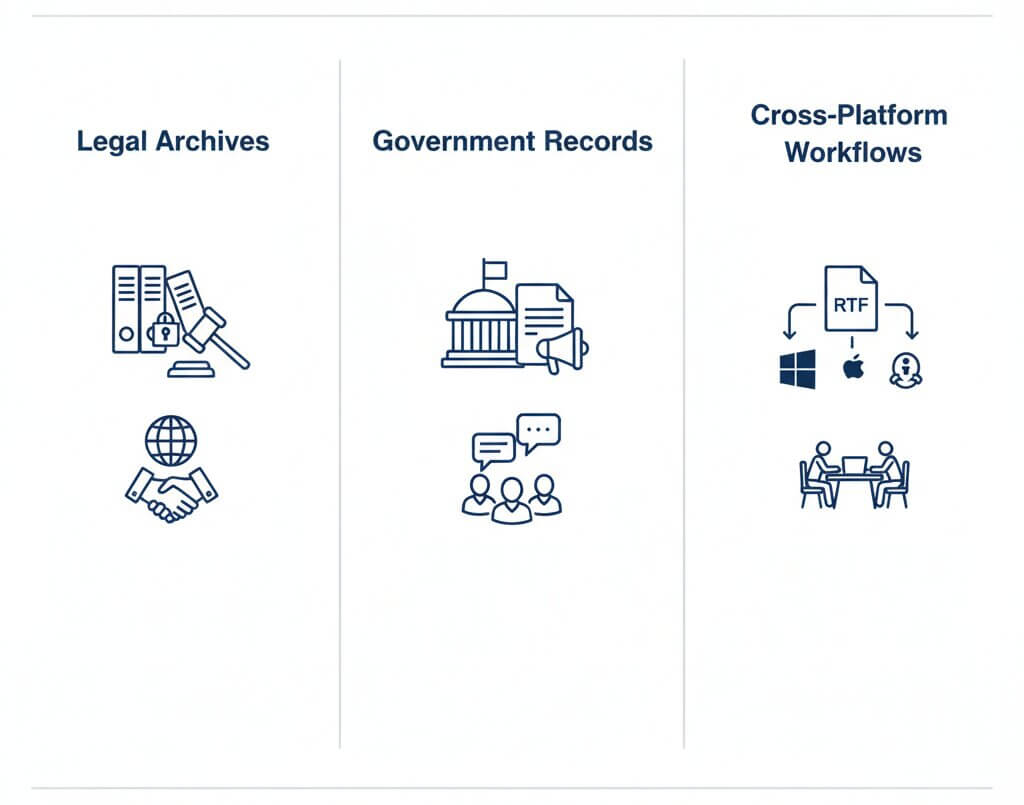
Law firms and legal departments often maintain historical contracts, case files, and depositions in RTF format because the format guarantees readability regardless of future software changes. When these documents need translation for international litigation or cross-border transactions, maintaining exact formatting is not just aesthetic - it is often a legal requirement.

Translated legal documents must preserve numbered paragraphs, indentation hierarchies, and citation formatting precisely. The RTF file translator keeps every structural element in its correct position, producing legally valid translations that satisfy court requirements and maintain evidentiary integrity across jurisdictions.

Government agencies accumulate decades of policy documents, regulations, and public records in RTF format due to its standardized nature and accessibility requirements. These institutions cannot risk file corruption when translating materials for multilingual populations or international cooperation agreements.

Public sector translation demands absolute reliability - files must open correctly on every citizen's computer regardless of their operating system or software version. The translator keeps RTF compatible with many systems. Translated documents stay accessible to as many people as possible.

Organizations with heterogeneous IT environments depend on RTF for document interchange. Marketing materials, HR policies, and training manuals distributed across diverse platforms need translation capabilities that respect this multi-platform reality.

When teams collaborate internationally using different operating systems and word processors, translated RTF files provide the common format everyone can open and edit. The rich text format translator enables seamless multilingual collaboration without forcing standardization on a single software platform, respecting the technical diversity of modern organizations.

online rtf translation use cases

Pricing

Try for free, no credit card required

Lite

$9 / mo
  • 400.000 characters per month
  • Advanced AI translation
  • Layout & formatting preservation
  • 100+ language support
Free Trial

Starter

$19 / mo
  • 1.000.000 characters per month
  • Advanced AI translation
  • Layout & formatting preservation
  • 100+ language support
Free Trial

Business

$49 / mo
  • 3.000.000 characters per month
  • Unlimited users & collaboration
  • All Pro features
  • Priority support
Free Trial
Save 25%

Yearly

$169 / year
  • 12.000.000 characters per year
  • Unlimited users & collaboration
  • All Pro features
  • Priority support
Free Trial

F.A.Q

Frequently Asked Questions

Rich text format files contain control codes like \b, \i, \fs, and \colortbl that define formatting. Standard translation tools cannot distinguish these codes from regular text, so they attempt to translate the control words themselves. This corrupts the RTF syntax and produces files that will not open properly. This rtf file translator parses the RTF structure to protect all formatting codes while translating only the visible text content.

Yes. The translator generates RTF 1.9-compliant output, which is supported by word processors dating back to the 1990s. This includes legacy versions of Microsoft Word, WordPad, LibreOffice, OpenOffice, and countless other applications. The translated files maintain backward compatibility with older software while remaining fully functional in modern applications.

RTF uses escape sequences to represent characters outside the basic ASCII range. The translator automatically generates the correct RTF encoding for every character in the target language, whether that is \'e9 for é in French, Unicode markers for Cyrillic, or complex escape sequences for Asian languages. Special characters display correctly in any application that opens the file.

Yes. RTF files can contain embedded images encoded as hexadecimal data and OLE objects for charts or spreadsheets. The rich text format translator identifies all binary sections and object references, protecting them from modification during translation. The translated file retains all embedded elements exactly as they appeared in the original document.

Absolutely. One of RTF's core design principles is cross-platform compatibility. The translator accepts RTF files created in Microsoft Word on Windows, Pages on macOS, LibreOffice on Linux, or any other application and platform combination. The translated output maintains the same universal compatibility and the file opens correctly everywhere.

Rich text format offers unmatched longevity and platform independence. Unlike proprietary formats that require specific software versions, RTF files can be opened and edited in virtually any word processor on any operating system. For organizations managing multilingual archives or collaborating across diverse IT environments, RTF provides a stable, universal format that will remain accessible for decades.

Most RTF files are translated within minutes. A standard 10-page document typically processes in under 90 seconds. Processing time scales with document size. The system must carefully parse the RTF structure to separate formatting codes from translatable text, which takes slightly longer than formats with simpler markup.

Yes. The parser understands RTF table syntax (\trowd, \cellx, \intbl) and column definitions (\cols, \colno). Complex layouts with merged cells, nested tables, and multi-column text are preserved precisely. The translator maintains all structural formatting codes so tables, columns, and advanced layouts remain unchanged in the translated file.

The system handles RTF files up to 200MB in size, which typically accommodates documents of several hundred pages. Most business and legal RTF files fall well below this threshold. For extremely large archives, split the document into sections before translation.

The service offers a free trial that allows testing the rtf file translator with sample documents. This demonstrates the format preservation and translation quality before committing to a subscription. Registration provides access to full features, higher volume limits, and the ability to save translation history for reference.