AI HTML Translator That Understands Code Structure

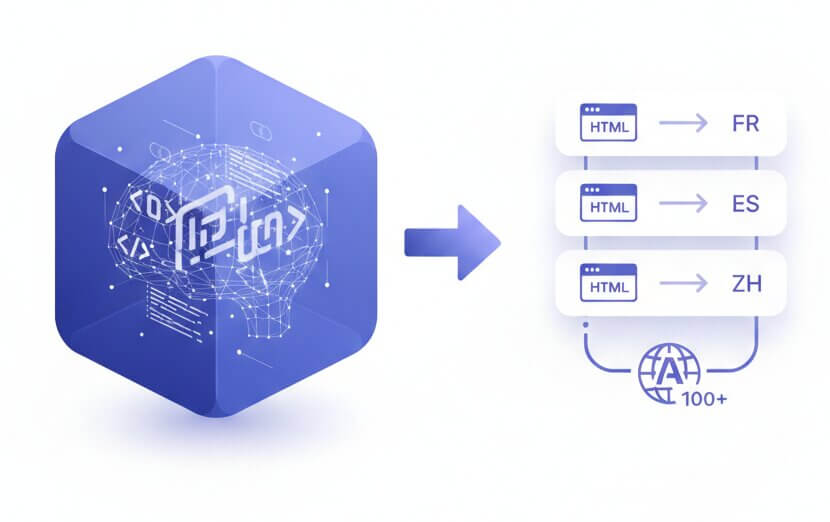
Automatically translate HTML files into 100+ languages

html translator online

Translate HTML File Content Without Touching the Code

Ship multilingual websites faster with intelligent HTML translation

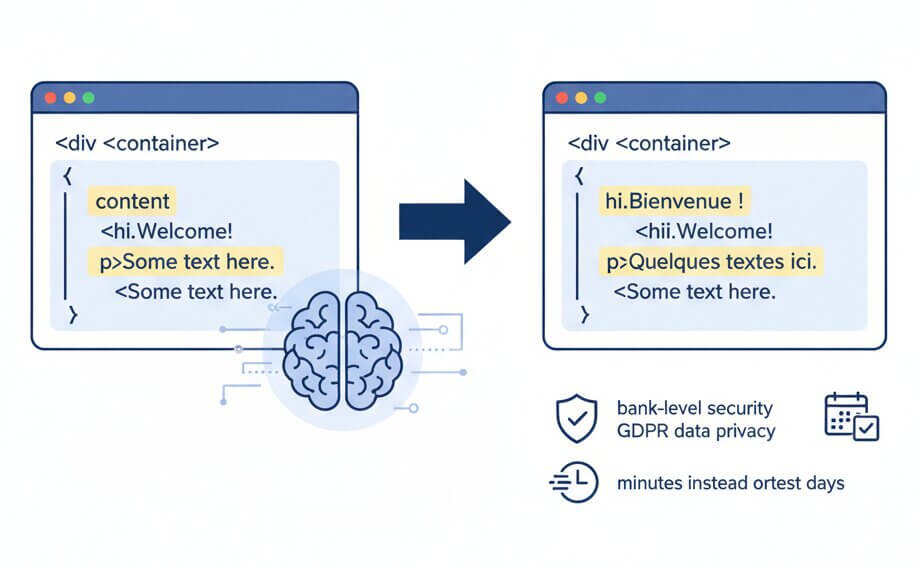
Localizing web pages has always been risky because traditional methods either break the markup or miss crucial elements. Our HTML translator uses AI parsing to distinguish between code and displayable text. It identifies paragraph content, headings, button labels, alt attributes, meta descriptions, and title tags, then translates only those elements. Every opening and closing tag, every CSS class name, every JavaScript variable, and every data attribute remains unchanged. The result is a fully functional translated HTML file ready for production. The service recognizes inline styles, preserves UTF-8 encoding, and handles nested structures without errors. Developers and localization teams can now translate entire static sites or email templates in minutes instead of days. Files are processed with bank-level security, and all translations meet GDPR standards for data privacy.
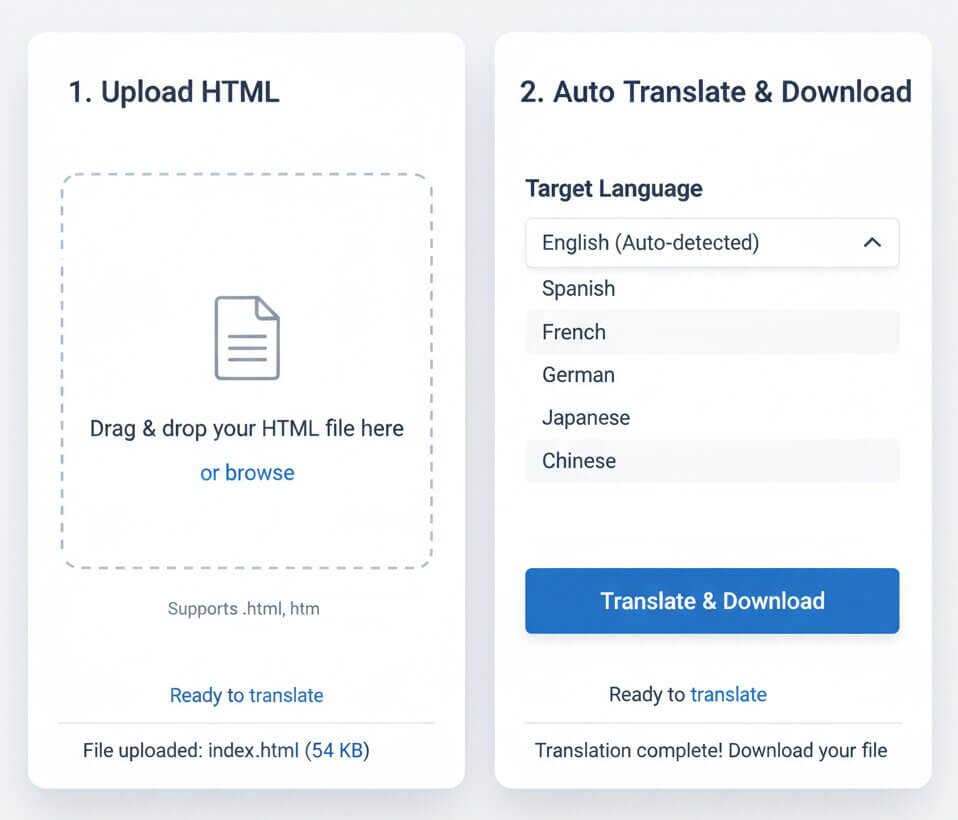
online html translator with layout preservation

How it Works

Three steps to localize HTML files instantly

Upload

Drop the HTML file into the translator interface. The system accepts single-page HTML, multi-file archives, or XHTML documents used for web development and email campaigns.

Auto Translate

Select the target language. The engine parses the DOM structure, extracts human-readable strings, and translates text nodes, attribute values, and metadata while ignoring markup and scripts.

Download

Receive a translated HTML file with identical structure. Open it in a browser to confirm that rendering, interactivity, and responsive behavior match the source version.

Features

Built for developers and localization professionals

html translation app

Code-Aware Parsing

Tag Preservation

Attribute Translation

Encoding Integrity

Multi-Language Output

Instant Processing

Why this HTML translator stands out

translate html while keeping formatting

Structure-Safe Translation

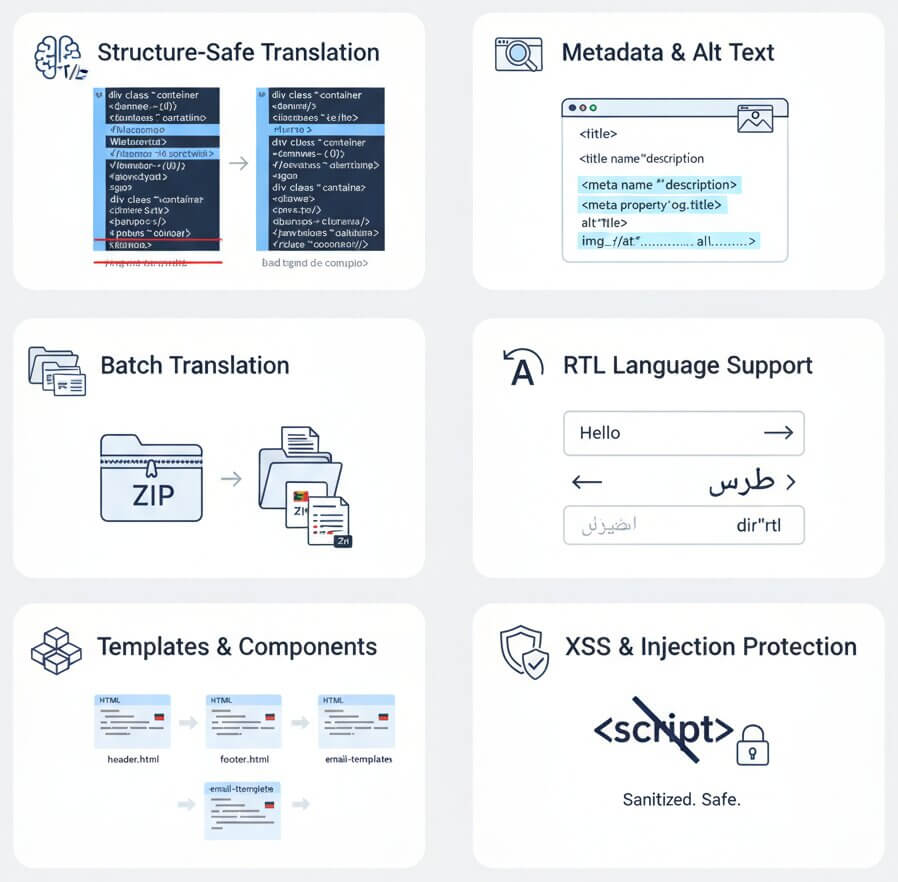
Generic translation tools treat HTML as plain text, which corrupts tags and causes rendering failures. The HTML translator parses the document tree to separate markup from content. Only visible text, such as paragraphs, list items, and button labels, gets translated. Inline styles, classes, IDs, and event handlers remain untouched.

Metadata and Alt Text Coverage

Search engine rankings and accessibility both depend on properly localized metadata. The system automatically translates title tags, meta descriptions, Open Graph properties, and alt attributes for images. This comprehensive approach helps the translated page perform well in search results and with screen readers.

Batch Translation for Sites

Localizing a static website with dozens of pages is slow when done manually. The translator accepts ZIP archives containing multiple HTML files and processes them in parallel. Each file is returned with its original directory structure, making deployment to a CDN or web server seamless.

Right-to-Left Language Support

Translating into Arabic, Hebrew, or Persian introduces directionality challenges. The engine respects text direction attributes so that translated content aligns correctly. Character encoding is preserved as UTF-8 to prevent garbled text in non-Latin scripts like Chinese, Japanese, or Cyrillic alphabets.

Template and Component Ready

Modern web development relies on reusable components and template partials. The translator handles HTML fragments without requiring a full document structure, so individual header snippets, footer sections, or email templates can be localized independently. This modular workflow fits into build pipelines for React, Vue, or static site generators.

XSS and Injection Protection

Security is critical when processing user-generated or third-party HTML. The system sanitizes potentially malicious code during parsing and never executes scripts. Output files are safe for production deployment without introducing cross-site scripting vulnerabilities or breaking Content Security Policy rules.

HTML translation scenarios for different teams

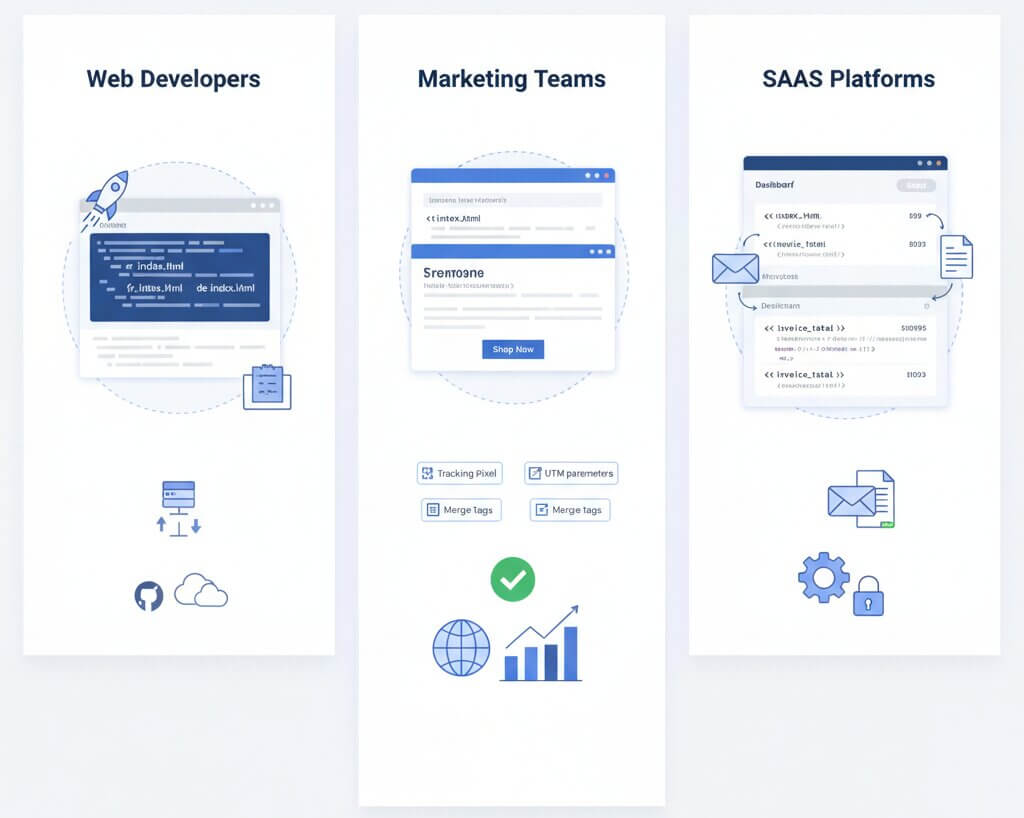
Developers building landing pages, documentation sites, or static blogs often need to launch in multiple languages. Manually copying text into translation memory tools and then re-inserting it into HTML is error-prone and slow.

The HTML translator integrates into build scripts using command-line APIs. Upload a source file in English, receive French and German versions in seconds, and commit them to version control. The workflow accelerates time-to-market for international releases.

Email campaigns and promotional landing pages require precise localization to maximize conversion rates. Marketing teams often design HTML emails in tools like MailChimp or HubSpot, where the code contains inline styles, tracking pixels, and UTM parameters.

Standard translation services break these elements, causing broken links or lost analytics data. The HTML translator preserves all tracking code, merge tags, and conditional comments. Campaigns can be deployed globally with confidence that click-through tracking and A/B testing infrastructure remain functional across languages.

SaaS applications generate dynamic HTML for user dashboards, transactional emails, and in-app help content. Localizing these templates usually requires splitting strings into resource files and managing keys across dozens of locales.

The HTML translator simplifies this by accepting template files with placeholders or Mustache-style variables. It translates surrounding text while ignoring variable syntax, so templates remain compatible with rendering engines. This is ideal for notification emails, PDF invoices, or admin panel widgets that need internationalization without refactoring the entire codebase.

online html translation use cases

Pricing

Start translating HTML files at no cost

Lite

$9 / mo
  • 400.000 characters per month
  • Advanced AI translation
  • Layout & formatting preservation
  • 100+ language support
Free Trial

Starter

$19 / mo
  • 1.000.000 characters per month
  • Advanced AI translation
  • Layout & formatting preservation
  • 100+ language support
Free Trial

Business

$49 / mo
  • 3.000.000 characters per month
  • Unlimited users & collaboration
  • All Pro features
  • Priority support
Free Trial
Save 25%

Yearly

$169 / year
  • 12.000.000 characters per year
  • Unlimited users & collaboration
  • All Pro features
  • Priority support
Free Trial

F.A.Q

Frequently Asked Questions

The translator uses a DOM parser to build a tree representation of the file. It walks through each node, identifies text content separate from markup, and translates only the displayable strings. Tags, class names, IDs, and inline scripts remain unchanged because they are never passed to the translation engine.

Yes. Script blocks, style declarations, and JSON-LD structured data are ignored during translation. Only visible text between HTML tags, along with alt and title attributes, is processed. Functionality and styling remain unchanged in the output file.

Absolutely. The HTML translator detects meta name and property attributes in the head section. It translates description, og:title, og:description, and twitter:card content, so the localized page displays correctly in search previews and social media shares.

The service preserves the original charset declaration, typically UTF-8, to support international characters. If the source file uses a different encoding, it is converted to UTF-8 during processing to prevent corruption of accented letters, emoji, or non-Latin scripts.

Yes. Email HTML often contains inline styles, conditional comments for Outlook, and tracking pixels. The translator respects all these elements and translates only the body text and alt attributes.

Yes. Upload a ZIP archive containing the site structure. The translator processes each HTML file independently and returns the archive with the same folder hierarchy. This batch feature is ideal for static site generators or documentation projects with dozens of pages.

Yes. The parser does not require a complete document with doctype and head tags. It accepts HTML fragments such as header partials, footer snippets, or individual card components. This makes it compatible with modern frameworks like React, Vue, or Handlebars.

The translator adds or preserves the dir attribute when the target language is Arabic, Hebrew, or Persian. If the source file lacks this attribute, it is inserted automatically. Text alignment and bidirectional Unicode markers are respected so that rendering appears correctly.

Individual HTML files up to 20 MB are processed instantly. Contact our support team for enterprise limits if working with very large documentation repositories.

If the source file is valid HTML5, the output will also be valid. The translator does not add or remove elements; it only changes text content. However, if the original contains validation errors, those will carry over to the translated version.